
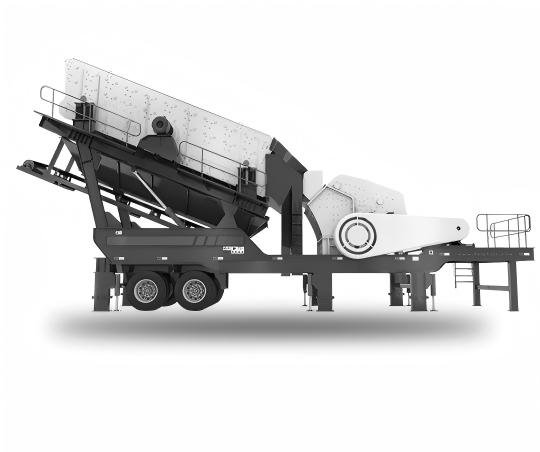

An engineering guide to mobile stone crusher types, specifications, capacities, and supplier evaluation — written for quarry operators, mining engineers, and construction project managers who need reliable crushing equipment on the move.
What Is a Mobile Stone Crusher?
A mobile stone crusher is a self-propelled or track-mounted crushing plant that processes rock, stone, ore, and construction waste directly at the working face. Unlike stationary crushers that require material to be hauled to a fixed location, mobile crushers move to the material — eliminating haul truck cycles, reducing fuel costs, and cutting material handling by 40–60%.
The mobile crushing market is growing fast. Global demand is driven by three forces: urban infrastructure renewal (construction waste recycling), aggregate quarry expansion in developing economies, and mining operations where ore body geometry changes frequently. If you’re sourcing a mobile stone crusher, the supplier you choose matters more than the spec sheet suggests — because after-sales support, wear parts availability, and customization capability determine whether your plant runs at 85% availability or 60%.
This guide covers the types, specifications, applications, and — most importantly — how to evaluate a mobile stone crusher supplier before committing $50,000 to $500,000 of your capital.
Types of Mobile Stone Crushers
Mobile crushing plants are classified by the crushing stage they perform and the mobility configuration.
By Crushing Stage
1. Mobile Jaw Crusher (Primary Crushing)
The jaw crusher is the workhorse of primary crushing. A fixed jaw and a movable jaw form a V-shaped crushing chamber. Material is compressed and fractured as the movable jaw oscillates.
Best for: Hard rock (granite, basalt, river stone, iron ore), abrasive materials, large feed sizes.
| Parameter | Range |
|---|---|
| Feed opening | 400 × 600 mm to 1,200 × 1,500 mm |
| Max feed size | 340–1,020 mm |
| Discharge range | 40–150 mm (adjustable) |
| Capacity | 15–800 tph |
| Motor power | 30–200 kW |
| Reduction ratio | 3:1 to 6:1 |
Typical configurations:
- Track-mounted with vibrating feeder + jaw crusher + belt conveyor (primary crushing station)
- Trailer-mounted for highway transport between sites
Why it’s the most common mobile crusher: Jaw crushers handle the widest range of feed sizes and material hardness. If you’re not sure what material you’ll encounter, a mobile jaw crusher is the safest primary choice.
2. Mobile Impact Crusher (Secondary / Tertiary Crushing)
Impact crushers use high-speed rotor-mounted blow bars to strike material against impact plates. The material fractures along natural cleavage planes, producing a more cubical product shape than compression crushers.
Best for: Medium-hard rock (limestone, concrete, asphalt recycling), aggregate production where cubical shape matters, construction waste processing.
| Parameter | Range |
|---|---|
| Rotor diameter × length | 850 × 800 mm to 1,320 × 1,500 mm |
| Max feed size | 300–500 mm |
| Discharge range | 10–40 mm (adjustable) |
| Capacity | 30–400 tph |
| Motor power | 55–250 kW |
| Reduction ratio | 10:1 to 25:1 (higher than jaw) |
Two sub-types:
- PF Series (horizontal shaft impactor, HSI): Standard secondary crusher for limestone and concrete
- VSI (vertical shaft impactor): Tertiary stage for sand making and shape improvement; produces 0–5 mm manufactured sand with good particle shape
Critical note: Impact crushers wear faster than jaw or cone crushers on abrasive materials (basalt, granite, river gravel with high silica content). Blow bar wear rate on basalt can reach 0.3–0.8 kg/ton of material processed. If your material has an Abrasion Index (Ai) >0.5, consider a cone crusher instead.
3. Mobile Cone Crusher (Secondary / Tertiary Crushing)
Cone crushers compress material between a mantle and a concave liner. They produce a more uniform product size distribution than impact crushers and handle abrasive, hard rock better.
Best for: Hard rock secondary/tertiary crushing (granite, basalt, copper ore, iron ore), high-wear applications.
| Parameter | Range |
|---|---|
| Cavity type | Extra-coarse, coarse, medium, fine |
| Max feed size | 35–300 mm (cavity-dependent) |
| Discharge range | 3–60 mm (adjustable) |
| Capacity | 27–600 tph |
| Motor power | 55–315 kW |
| Reduction ratio | 4:1 to 8:1 |
Why choose cone over impact for hard rock: Cone crusher liners last 2–4× longer than impact crusher blow bars on the same abrasive material. For a 200 tph granite crushing plant, this means 1 liner change per 2–3 months (cone) vs. blow bar changes every 2–3 weeks (impact). The downtime and parts cost difference is significant over a year.
4. Mobile Hammer Crusher (Primary / Secondary)
Hammer crushers use rotating hammers to shatter material by impact and shear. They combine primary and secondary crushing in one unit — producing 0–40 mm discharge in a single pass.
Best for: Brittle, medium-hard materials (limestone, coal, gypsum, coke, construction waste). Not suitable for abrasive hard rock.
| Parameter | Range |
|---|---|
| Rotor diameter × length | 1,000 × 800 mm to 1,600 × 1,400 mm |
| Max feed size | 200–600 mm |
| Discharge range | 0–25 mm (with grate bar) |
| Capacity | 20–500 tph |
| Motor power | 55–400 kW |
Advantage: Single-stage crushing reduces capital cost and footprint. Limitation: Hammer wear is aggressive on hard materials; grate bars blind with wet/sticky feed.
5. Mobile Combined Crushing Plant (Multi-Stage)
A combined plant integrates two or more crusher types on a single mobile chassis or as a coordinated multi-unit system. The most common configuration:
Best for: Aggregate production requiring multiple product sizes (0–5 mm, 5–10 mm, 10–20 mm, 20–40 mm), large-scale quarry operations, mining applications.
| Configuration | Capacity | Feed Size | Product Sizes |
|---|---|---|---|
| Jaw + Impact (2-stage) | 50–400 tph | <500 mm | 0–40 mm (3 fractions) |
| Jaw + Cone (2-stage) | 50–500 tph | <500 mm | 0–40 mm (3 fractions) |
| Jaw + Impact + Screen (3-stage) | 80–350 tph | <500 mm | 0–5, 5–10, 10–20, 20–40 mm |
| Jaw + Cone + VSI (3-stage) | 80–300 tph | <500 mm | 0–5 mm sand + 3 aggregate fractions |
By Mobility Configuration
| Type | Description | Best For | Transit Speed |
|---|---|---|---|
| Track-mounted | Hydraulic crawler tracks; self-propelled; no truck needed to relocate | Quarries with rough terrain; frequent repositioning within a site | 10–20 m/min (very slow, on-site only) |
| Tire-mounted (semi-mobile) | Trailer-mounted with tires; towed by truck on highways | Multi-site contractors; projects with multiple locations | Highway-legal (60–80 km/h transport) |
| Skid-mounted | No wheels or tracks; relocated by crane or flatbed | Semi-permanent installations with occasional relocation | Crane-lift only |
Track vs. Tire — how to choose:
| Criterion | Track-Mounted | Tire-Mounted |
|---|---|---|
| Terrain capability | Rough, sloped, soft ground | Paved or compacted surfaces only |
| Setup time | 10–30 minutes (hydraulic legs) | 30–60 minutes (jack stands) |
| Highway transport | Not road-legal; lowboy trailer needed | Self-propelled on highway |
| Capital cost | +15–25% vs tire | Baseline |
| Maintenance | Track undercarriage needs service every 500–1,000 hours | Tires + bearings; simpler |
| Best fit | Mining, large quarry, single-site long-term | Construction contractor, multi-site, road project |
Mobile Stone Crusher Specifications — Standard Models
Mobile Jaw Crusher Plants
| Model | Feed Opening (mm) | Max Feed (mm) | Capacity (tph) | Motor (kW) | Weight (t) |
|---|---|---|---|---|---|
| YG-938E69 | 600 × 900 | 500 | 50–180 | 55–75 | 14 |
| YG-1142E710 | 1,070 × 750 | 630 | 110–250 | 90–110 | 22 |
| YG-1349E912 | 1,200 × 900 | 750 | 150–320 | 132 | 28 |
| YG-1560E1518 | 1,500 × 1,200 | 1,020 | 300–600 | 200 | 45 |
Mobile Impact Crusher Plants
| Model | Rotor Ø × L (mm) | Max Feed (mm) | Capacity (tph) | Motor (kW) | Weight (t) |
|---|---|---|---|---|---|
| YG-938F1210 | 1,200 × 1,000 | 350 | 50–120 | 90–110 | 16 |
| YG-1142F1315 | 1,320 × 1,500 | 500 | 100–280 | 160–200 | 26 |
| YG-1560F1620 | 1,600 × 2,000 | 600 | 200–400 | 250 | 38 |
Mobile Cone Crusher Plants
| Model | Cone Type | Max Feed (mm) | Capacity (tph) | Motor (kW) | Weight (t) |
|---|---|---|---|---|---|
| YG-938H80 | PYB-900 | 115 | 50–90 | 55 | 15 |
| YG-1142H1200 | PYB-1200 | 180 | 100–200 | 110 | 25 |
| YG-1560H1750 | PYB-1750 | 240 | 200–350 | 160 | 35 |
Mobile VSI Sand Making Plants
| Model | Rotor Ø (mm) | Max Feed (mm) | Capacity (tph) | Motor (kW) | Product Size |
|---|---|---|---|---|---|
| YG-938V7611 | 760 | 35 | 30–60 | 55–90 | 0–5 mm sand |
| YG-1142V9526 | 950 | 45 | 80–150 | 110–160 | 0–5 mm sand |
| YG-1560V1145 | 1,140 | 50 | 150–250 | 200–250 | 0–5 mm sand |
Applications
1. Quarry Aggregate Production
The largest application for mobile stone crushers. Quarries produce graded aggregate (0–5 mm sand, 5–10 mm, 10–20 mm, 20–40 mm gravel) for concrete, asphalt, and road base.
Typical circuit for a 200 tph granite quarry:
→ Mobile Jaw Crusher (primary, discharge 80–120 mm)
→ Mobile Cone Crusher (secondary, discharge 20–40 mm)
→ Mobile Impact Crusher or VSI (tertiary, 0–5 mm sand)
→ Vibrating Screen (3–4 decks)
→ Stockpiles (4 product fractions)
Key parameters:
- Granite compressive strength: 120–200 MPa
- Required product: 0–5 mm (sand), 5–10 mm, 10–20 mm, 20–40 mm
- Jaw liner life: 800–1,200 hours on granite
- Cone liner life: 1,500–2,500 hours on granite
- Total energy: 2.5–4.0 kWh/t (multi-stage)
2. Construction Waste Recycling
Demolition concrete, brick, and asphalt are recycled into road base material, recycled aggregate (RCA), and fill material. Mobile crushers process waste on-site, eliminating disposal costs ($30–80/ton landfill fees in most countries).
Typical circuit for 150 tph construction waste:
→ Mobile Impact Crusher (primary + secondary in one pass)
→ Vibrating Screen
→ 0–20 mm recycled aggregate
→ 20–40 mm road base
→ Oversize return → re-crush
Key parameters:
- Feed: mixed concrete, brick, asphalt, wood, steel (magnet removes rebar)
- Product: 0–20 mm (road base), 20–40 mm (drainage fill)
- Impact crusher preferred: handles mixed materials better than jaw/cone
- Magnetic separator + hand picking for steel removal
- Capacity: 80–250 tph
3. Mining and Ore Crushing
Mobile crushers are used in open-pit mines for in-pit crushing — reducing haul truck distances and enabling IPCC (In-Pit Crushing and Conveying) systems.
Applications by ore type:
| Ore Type | Primary Crusher | Capacity (tph) | Feed Size | Product P80 |
|---|---|---|---|---|
| Gold ore (oxide) | Mobile jaw | 50–200 | <300 mm | <80 mm |
| Gold ore (sulfide) | Mobile jaw | 100–300 | <400 mm | <80 mm |
| Copper ore | Mobile jaw or cone | 200–800 | <600 mm | <100 mm |
| Iron ore | Mobile jaw | 200–500 | <500 mm | <80 mm |
| Coal | Mobile hammer or sizer | 100–1,000 | <500 mm | <50 mm |
4. Road Construction
Mobile crushers produce road base and sub-base material directly along the highway alignment — critical for remote road projects where transporting aggregate from a stationary plant is uneconomical.
Typical setup for a 50 km road project:
- Mobile jaw crusher relocated every 5–8 km along the alignment
- Feed: excavated rock from cuts, river gravel from local sources
- Product: 0–40 mm road base, 0–20 mm sub-base
- Capacity: 100–250 tph
- Diesel-electric drive: operates without grid power
5. River Stone / Pebble Processing
River stones (pebbles, cobbles) are processed into aggregate for concrete and decorative stone. The high silica content (SiO₂ >70%) makes this an abrasive application.
Recommended circuit: Jaw (primary) → Cone (secondary) → VSI (tertiary for sand)
Avoid: Impact crushers — blow bar wear rate on river pebbles exceeds 0.5 kg/ton, making them uneconomical.
How to Evaluate a Mobile Stone Crusher Supplier
This is where most buyers make mistakes. The crusher spec sheet looks similar across suppliers, but the supplier’s engineering capability, parts inventory, and response time determine your plant’s lifetime availability. Here’s a structured evaluation framework.
Criterion 1: Manufacturing Capability
| Question | What to Look For | Red Flag |
|---|---|---|
| Do they manufacture or trade? | Manufacturer = factory visit possible, custom designs, OEM warranty | Trading company = markup on price, no factory access, generic specs |
| What’s their production capacity? | Minimum 5,000 m² factory; 50+ employees; ISO 9001 certification | Cannot provide factory photos/video; no certifications |
| Can they customize? | Non-standard feed openings, motor brands (Siemens/ABB), voltage/frequency (440V/60Hz for Americas) | “Standard models only” = they’re a trader, not a manufacturer |
Criterion 2: Technical Documentation
A serious supplier provides these before you pay a cent:
- ✅ General arrangement drawings (PDF or DWG)
- ✅ Equipment list with brand names for motors, bearings, hydraulic components
- ✅ Wear parts list with expected life per material type
- ✅ Foundation or track mounting drawings
- ✅ Electrical schematic and control panel layout
If the supplier can’t provide these within 3–5 days, they either don’t have engineering capability or they’re reselling someone else’s product.
Criterion 3: Wear Parts and After-Sales Support
Wear parts are where suppliers make long-term margin — and where buyers incur hidden costs. Ask these questions:
| Wear Part | Expected Life (limestone) | Expected Life (granite) | Price Range (USD) |
|---|---|---|---|
| Jaw plate (fixed + movable) | 2,000–3,000 hours | 800–1,200 hours | $400–2,500/set |
| Impact blow bars | 1,500–2,500 hours | 300–600 hours | $300–1,800/set |
| Cone mantle + concave | 3,000–5,000 hours | 1,500–2,500 hours | $800–4,000/set |
| Hammer crusher hammers | 2,000–3,000 hours | 500–1,000 hours | $200–1,200/set |
| Screen mesh (polyurethane) | 6–12 months | 4–8 months | $50–400/panel |
What to ask the supplier:
- “Do you stock wear parts for this model year-round?” (If no, you’ll wait 4–8 weeks for each reorder)
- “Can you ship wear parts by air express in 5–7 days?” (Critical for remote sites)
- “What’s the warranty on mainframe vs. wear parts?” (Typical: 12 months mainframe, 6 months wear parts, no warranty on consumables)
- “Do you provide a wear parts list with part numbers I can reorder?” (If no, you’re locked into buying from them at whatever price they set)
Criterion 4: Commissioning and Installation
| Service Level | What’s Included | Typical Cost |
|---|---|---|
| Basic (FOB shipment) | Machine + drawings only; buyer handles all installation | $0 (included in price) |
| Standard (CIF + guide) | Shipment + 1 engineer on-site for 5–7 days commissioning | $2,000–5,000 (flights, hotel, daily rate) |
| Full (turnkey) | Shipment + installation crew + commissioning + operator training | $8,000–25,000 |
For first-time buyers: Always pay for the Standard commissioning service. A mobile crusher that’s not aligned, tensioned, and test-run by an experienced engineer will have chronic belt tracking issues, bearing failures, and screen blinding for the rest of its life.
Criterion 5: Price Transparency
Mobile stone crusher prices vary widely based on configuration, manufacturer origin, and included services. Here’s a realistic price range breakdown:
| Configuration | Capacity | Price Range (FOB China) | Price Range (CIF Africa/SE Asia) |
|---|---|---|---|
| Mobile jaw crusher (track) | 50–180 tph | $28,000–$85,000 | $38,000–$110,000 |
| Mobile jaw crusher (track) | 180–400 tph | $65,000–$180,000 | $85,000–$220,000 |
| Mobile impact crusher (track) | 50–200 tph | $35,000–$95,000 | $45,000–$120,000 |
| Mobile impact crusher (track) | 200–400 tph | $80,000–$200,000 | $105,000–$245,000 |
| Mobile cone crusher (track) | 100–300 tph | $60,000–$160,000 | $78,000–$195,000 |
| Mobile VSI sand maker (track) | 50–150 tph | $40,000–$110,000 | $52,000–$135,000 |
| Combined plant (jaw + impact + screen) | 100–300 tph | $85,000–$280,000 | $110,000–$340,000 |
Why the wide ranges:
- Motor brand: Chinese motor ($1,500) vs Siemens/ABB ($6,000–12,000) — 3× price difference
- Hydraulic components: Chinese vs Bosch Rexroth/Kawasaki — 2.5× price difference
- Track system: Light-duty (D6 equivalent) vs heavy-duty (D9 equivalent) — 1.8× price difference
- Steel plate thickness: 16 mm (light) vs 25 mm (heavy-duty) — affects weight, rigidity, and price by 30–40%
- Control system: Manual switches vs PLC + HMI touchscreen — $3,000–8,000 difference
The supplier question that reveals everything: “What brand of motor, bearings, and hydraulic valves do you use?” If they can’t answer immediately, they’re a trading company. If they answer with specific brands and can substitute on request, they’re a manufacturer.
Criterion 6: Export Experience
| Indicator | What It Tells You |
|---|---|
| 10+ years of export history | They’ve solved shipping, customs, and voltage/frequency issues before |
| References in your region | Climate-adapted designs (tropical cooling, dust sealing for desert) |
| CE certification (if you’re in Europe) | Meets EU machinery safety standards |
| ISO 9001 certification | Basic quality management system (necessary but not sufficient) |
| English-language technical documents | Critical for non-Chinese-speaking operators |
| WhatsApp/WeChat technical support | Fast communication for troubleshooting (not just email) |
Common Supplier Problems (And How to Avoid Them)
Problem 1: Spec Sheet Exaggeration
What happens: Supplier quotes “200 tph capacity” but the fine print says “capacity based on limestone, 50 mm feed, 20 mm discharge.” Your actual material (granite, 200 mm feed, 40 mm discharge) yields 110–130 tph.
How to avoid: Ask the supplier to state capacity at YOUR material type, feed size, and discharge size. If they won’t, find another supplier. The capacity should be specified at a specific bulk density (typically 1.6 t/m³ for aggregate, 2.7 t/m³ for iron ore).
Problem 2: Hidden Shipping Costs
What happens: FOB price looks attractive. Then you discover: inland transport from factory to port ($2,000–8,000), port fees ($500–2,000), ocean freight ($3,000–18,000), destination port charges, customs duties (5–25% of CIF value), and inland transport to your site.
How to avoid: Ask for a CIF or DDP quote, not just FOB. A serious supplier provides a landed-cost estimate including freight, insurance, and estimated duties. The gap between FOB and delivered cost is typically 25–55% of the FOB price.
Problem 3: No Local Parts Stock
What happens: Your blow bars wear out in 3 weeks. You order replacements. The supplier ships from China — 35–50 days by sea. Your plant is down for 5+ weeks.
How to avoid: Before purchase, ask the supplier: “Do you have any parts stock in my country or region?” Also: “What’s the air freight cost and time for urgent parts?” For critical wear parts, order one spare set with the initial machine purchase.
Problem 4: Voltage and Frequency Mismatch
What happens: Crusher arrives with 380V/50Hz motors. Your site has 460V/60Hz (Americas) or 415V/50Hz (Australia/India). Motors burn out or underperform.
How to avoid: Specify your site voltage and frequency in the PO. A manufacturer will customize the motor winding. A trading company can’t — they’ll ship standard 380V/50Hz and hope you don’t notice until after payment.
Problem 5: “Manufacturer” That’s Actually a Trader
Red flags that a “manufacturer” is really a trading company:
- Cannot provide factory photos with their logo on the building
- Cannot provide factory address for a site visit
- Response time >24 hours for technical questions (they’re asking the real factory)
- Price is 15–30% higher than direct factory quotes
- Cannot customize specifications or motor brands
- “Factory tour” is always “not convenient this month”
How to verify: Ask for a live video call showing the factory floor and the machine you’re buying. A real manufacturer can do this in 30 minutes. A trader will stall for days.
Mobile Stone Crusher Total Cost of Ownership (5-Year)
Purchase price is 20–35% of the 5-year total cost. Here’s the real cost picture for a 200 tph mobile jaw + impact combined plant.
| Cost Category | Annual Cost (USD) | 5-Year Cost (USD) | % of TCO |
|---|---|---|---|
| Capital (amortized) | — | 85,000 | 22% |
| Diesel fuel | 112,000 | 560,000 | 43% |
| Wear parts | 28,000 | 140,000 | 11% |
| Maintenance | 12,000 | 60,000 | 5% |
| Operator labor | 15,000 | 75,000 | 6% |
| Freight + duties on parts | 6,000 | 30,000 | 2% |
| Downtime cost | 12,000 | 60,000 | 5% |
| Insurance | 4,000 | 20,000 | 2% |
| Total | 189,000 | 1,030,000 | 100% |
Key insight: Fuel is 43% of TCO. A 10% improvement in fuel efficiency (through proper crusher setting, feed regulation, and engine maintenance) saves $56,000 over 5 years — more than half the capital cost of the machine.
Why Mingyuan Machinery?
We manufacture mobile stone crushers at our factory in Henan, China. We’re not a trading company — you can visit our factory, see your machine being built, and customize every specification. Here’s what that means for you in practice.
| What We Do | What Many “Suppliers” Do |
|---|---|
| Factory: 12,000 m², 80+ workers, ISO 9001 | Office + website; no factory |
| Custom motor voltage/frequency (380V/50Hz, 440V/60Hz, 415V/50Hz) | Standard 380V/50Hz only |
| Motor brands: Chinese standard or Siemens/ABB on request | Whatever the factory uses |
| Wear parts stocked year-round for all active models | Parts ordered from factory after you pay |
| Engineer on-site commissioning available (5–7 days) | “Read the manual” |
| WhatsApp technical support: response within 4 hours | Email only; 24–48 hour response |
| Factory video call before purchase | Stock photos only |
| CE and ISO certifications available on request | “We have certifications” (can’t produce them) |
Our mobile crusher product range:
| Category | Models | Capacity Range | Price Range (FOB) |
|---|---|---|---|
| Mobile jaw crusher | 4 standard + custom | 50–600 tph | $28,000–$180,000 |
| Mobile impact crusher | 3 standard + custom | 50–400 tph | $35,000–$200,000 |
| Mobile cone crusher | 3 standard + custom | 50–350 tph | $60,000–$160,000 |
| Mobile VSI sand maker | 3 standard + custom | 30–250 tph | $40,000–$110,000 |
| Mobile hammer crusher | 3 standard + custom | 20–500 tph | $25,000–$120,000 |
| Combined crushing plants | Custom configurations | 50–400 tph | $85,000–$280,000 |
What we don’t do:
- We don’t quote unrealistic capacities. If your granite yields 130 tph on a 200 tph-rated plant, we’ll tell you before you buy.
- We don’t hide the factory. Video call or in-person visit — your choice.
- We don’t disappear after delivery. WhatsApp support and parts supply for the life of the machine.
Get a Quote
Tell us what you’re crushing and we’ll recommend the right plant configuration — no guesswork, no upsell.
What to include in your inquiry:
- Material type (limestone, granite, basalt, river stone, concrete, ore, etc.)
- Material feed size (max and typical)
- Required product sizes (e.g., 0–5 mm, 5–10 mm, 10–20 mm, 20–40 mm)
- Required capacity (tph)
- Mobility preference (track-mounted, tire-mounted, or skid-mounted)
- Site voltage and frequency (e.g., 440V/60Hz, 380V/50Hz)
- Destination port (for CIF freight quote)
- Any special requirements (dust suppression, magnetic separator, dual-power diesel-electric)
Contact Us Directly
What you’ll receive:
- Equipment recommendation with reasoning (within 24 hours)
- Formal quotation with specifications and price (within 3–5 business days)
- Technical drawings and wear parts list (with the quotation)
- Shipping cost estimate to your destination port (included in the quotation)
We’ve supplied mobile crushing equipment to quarries, mines, and construction companies across Africa, Southeast Asia, Central Asia, and South America. Whether you need a single 50 tph jaw crusher plant or a multi-stage 400 tph aggregate production system, we have the engineering capability and manufacturing capacity to deliver.
This guide reflects 20+ years of crushing equipment manufacturing and field experience at Mingyuan Machinery. Specifications are based on standard models; custom configurations are available for specific material types, site conditions, and capacity requirements. For detailed engineering recommendations, contact our technical team directly.