
Mobile Crushing Plant: Complete Guide to Types, Specifications & Selection
Mobile stone crusher plants for quarry, mining, construction waste recycling, and aggregate production — engineered for mobility, productivity, and low operating cost.
What Is a Mobile Crushing Plant?
A mobile crushing plant is a self-propelled crushing and screening system that processes rock, stone, ore, and construction waste directly at the working face. Unlike stationary crushers that require material to be hauled to a fixed location, mobile crushers move to the material — eliminating haul truck cycles, reducing fuel costs, and cutting material handling by 40–60%.
Mobile crushing plants are classified by mobility type (tyre-mounted, crawler-mounted, or semi-mobile/skid-mounted) and by crusher type (jaw, impact, cone, or sand-making). A mobile stone crusher plant typically includes a vibrating feeder, a primary or secondary crusher, a vibrating screen, and discharge conveyors — all integrated on a single mobile chassis.
The global mobile crusher market is growing rapidly, driven by urban infrastructure renewal (construction waste recycling), aggregate quarry expansion, and mining operations where ore body geometry changes frequently. If you’re investing $45,000–$500,000 in a mobile rock crusher, the configuration you choose will determine your productivity, operating cost, and return on investment for the next 5–10 years.
Types of Mobile Crushing Plants
We manufacture 11 types of mobile crusher plants across three mobility platforms. Below is the complete catalog with specifications.
| Platform | Drive Method | Best For | Mobility | Price Range (USD) |
|---|---|---|---|---|
| Tyre-Mounted | Towed by truck | Quarries, fixed-site projects with occasional relocation | Medium | $45,000–$180,000 |
| Crawler-Mounted | Self-propelled tracks | Mining, rugged terrain, frequent relocation | High | $80,000–$350,000 |
| Semi-Mobile / Skid-Mounted | Relocated by crane/flatbed | Large-scale mining, long-term projects | Low (periodic) | $60,000–$250,000 |
| Mini Crawler | Self-propelled tracks | Small sites, pilot plants, rental fleets | High (compact) | $15,000–$45,000 |
Tyre-Mounted Mobile Crusher Plants
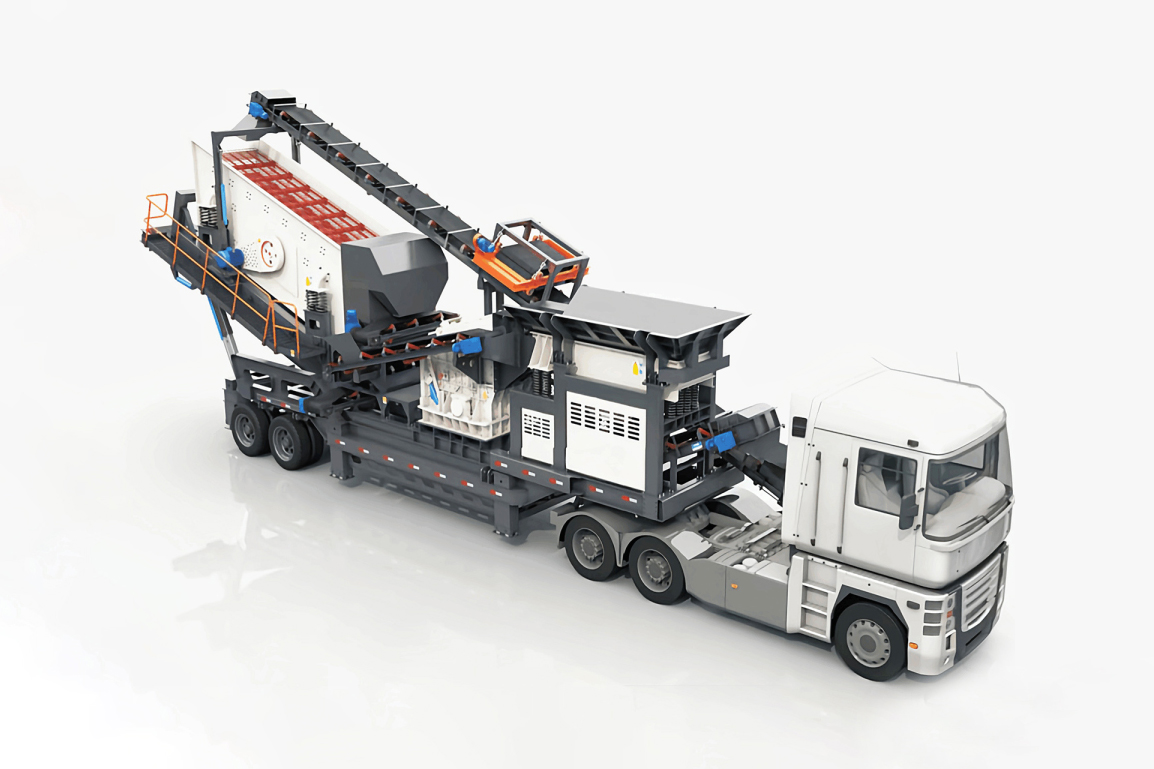
Tyre mobile crushing plants are mounted on a wheeled chassis with pneumatic tyres. They are towed to site by a standard truck tractor, set up within hours, and relocated quickly between job sites. Ideal for aggregate quarries, construction waste recycling yards, and road construction projects.
1. Tyre Mobile Jaw Crushing Plant
The tyre mobile jaw crushing plant is the most popular primary crushing solution for hard rock (granite, basalt, river stone, iron ore). It combines a vibrating feeder, jaw crusher, and discharge conveyor on a single wheeled chassis.
| Capacity | 100–200 t/h |
| Vibrating Feeder | ZSW9638 |
| Jaw Crusher Model | PE-600×900 |
| Max. Feeding Size | 500 mm |
| Motor Power (total) | 110–130 kW |
| Transport Weight | 25–32 tons |
Best for: Primary crushing of hard rock (granite, basalt, quartzite, iron ore) with compressive strength ≤320 MPa. Jaw liners last 800–1,200 hours on granite (Wi = 15–18).
2. Tyre Mobile Impact Crushing Plant
The tyre mobile impact crushing plant uses an impact crusher (horizontal shaft impactor) for primary or secondary crushing. Produces cubical-shaped aggregate ideal for concrete and asphalt.
| Capacity | 100–200 t/h |
| Impact Crusher Model | PFW-1214 |
| Vibrating Screen | 4YK-1860 (4-deck) |
| Max. Feeding Size | 430 mm |
| Motor Power (total) | 130–160 kW |
| Transport Weight | 28–35 tons |
Best for: Limestone, construction waste recycling, and medium-hard rock. Produces Type-1 aggregate with flakiness index <15%. Blow bar wear rate: 0.3–0.8 kg/ton on limestone.
3. Tyre Mobile Cone Crushing Plant
The tyre mobile cone crushing plant is designed for secondary and tertiary crushing of hard and abrasive materials. Pairs with a mobile jaw plant in two-stage circuits.
| Capacity | 60–100 t/h |
| Cone Crusher Model | PYB-900 |
| Vibrating Screen | 3YK-1548 (3-deck) |
| Max. Feeding Size | 160 mm |
| Motor Power (total) | 75–90 kW |
| Transport Weight | 22–28 tons |
Best for: Secondary/tertiary crushing of granite, basalt, river pebbles, and abrasive ores. Liner life: 1,500–3,000 hours (2–4× longer than impact blow bars).
4. Tyre Mobile Sand-Making Machine
The tyre mobile sand-making plant integrates a VSI (vertical shaft impact) crusher with a vibrating screen for manufactured sand production. Produces 0–5 mm sand meeting ASTM C33 / GB/T 14684 standards.
| Capacity | 80–150 t/h |
| Sand Maker Model | VSI-8518 |
| Vibrating Screen | YKR-1548 |
| Max. Feeding Size | 40 mm |
| Motor Power (total) | 110–150 kW |
| Sand Fineness Modulus | 2.6–3.0 (adjustable) |
Best for: Manufactured sand from granite, limestone, tailings, and pebbles. Impeller tip wear: 1,500–2,500 hours.
5. Tyre Mobile Screening Plant
The tyre mobile screening plant is a standalone vibrating screen unit on wheels. Used for pre-screening before crushing, product sizing, or as a complement to any mobile crusher.
| Capacity | 60–250 t/h |
| Vibrating Screen Model | 3YKR-1560 (3-deck) |
| Max. Feeding Size | 250 mm |
| Screen Area | 9–12 m² |
| Mesh Sizes | Customizable (5–80 mm) |
| Motor Power | 15–22 kW |
Best for: Product classification in multi-stage aggregate plants. Separates 3–4 product fractions in a single pass.
Crawler-Mounted Mobile Crusher Plants
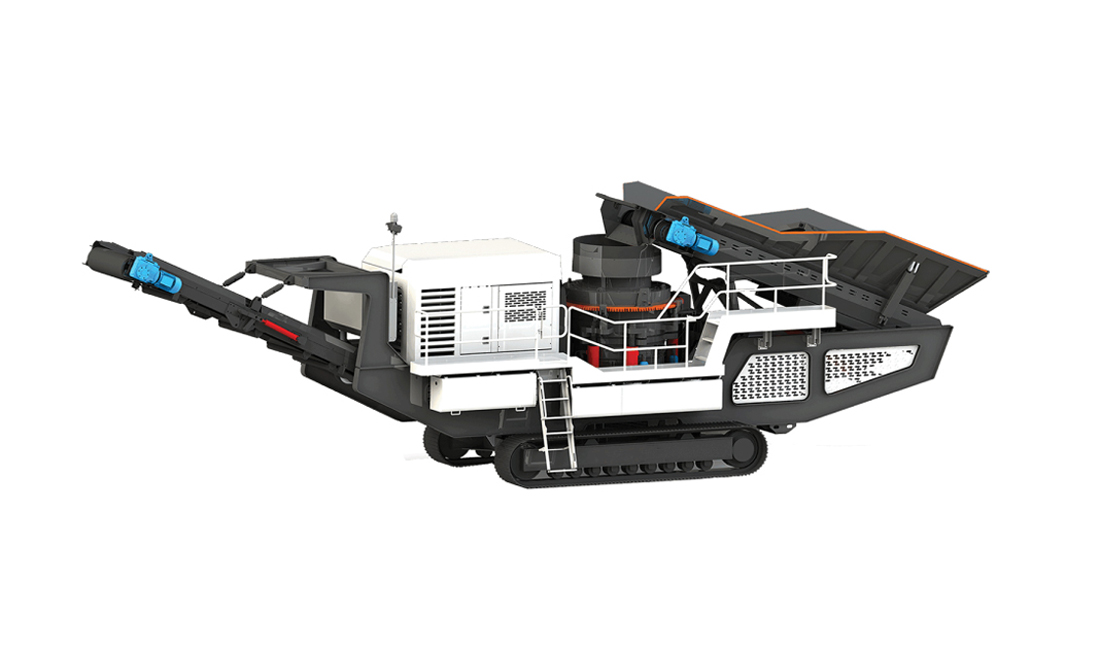
Crawler mobile crushers are mounted on heavy-duty steel tracks and are self-propelled — no truck tractor needed. They can crawl at 10–15 m/min across rough terrain, making them ideal for mining, quarry relocation, and demolition sites.
6. Crawler Mobile Jaw Crusher
The crawler mobile jaw crusher is a track-mounted primary crushing plant for hard rock. Hydraulic track drive allows on-site repositioning without external transport.
| Capacity | 150–360 t/h |
| Vibrating Feeder | GZT/ZSW-4211 |
| Jaw Crusher Model | C-106 (or PE-750×1060) |
| Max. Feeding Size | 580 mm |
| Crawl Speed | 10–15 m/min |
| Gradeability | ≤25° |
| Motor Power (total) | 160–200 kW |
| Operating Weight | 35–45 tons |
Best for: Primary crushing in mining and large quarry operations. Diesel-electric drive option allows operation without grid power.
7. Crawler Mobile Impact Crusher
The crawler mobile impact crusher combines an impact crusher with a vibrating screen on a tracked chassis. Designed for recycling, demolition, and medium-hard rock.
| Capacity | 100–300 t/h |
| Vibrating Feeder | GZT/ZSW-3895 |
| Impact Crusher Model | NP-1110M / CI-150 |
| Max. Feeding Size | 600 mm |
| Crawl Speed | 10–15 m/min |
| Gradeability | ≤20° |
| Motor Power (total) | 180–250 kW |
| Operating Weight | 32–42 tons |
Best for: Construction waste recycling (concrete, asphalt), limestone quarrying, and coal crushing. High reduction ratio up to 30:1.
8. Crawler Mobile Cone Crusher
The crawler mobile cone crusher is a track-mounted secondary/tertiary crushing plant for hard and abrasive materials. Pairs with a crawler jaw crusher in two-stage circuits.
| Capacity | 100–280 t/h |
| Vibrating Screen | 2YKR-1435 (2-deck) |
| Cone Crusher Model | MHP-200 / MCH-430 |
| Max. Feeding Size | 200 mm |
| Motor Power (total) | 160–220 kW |
| Operating Weight | 30–40 tons |
Best for: Secondary crushing of granite, basalt, copper/gold ore, and river pebbles. Mantle and concave life: 2,000–4,000 hours. Tramp iron release system standard.
9. Mini Crawler Mobile Jaw Crusher (3–10 t/h)
The mini crawler mobile jaw crusher is a compact, lightweight crushing plant for small-scale operations. Fits through standard gates and works in confined spaces.
| Capacity | 3–10 t/h |
| Jaw Crusher Model | PE-150×250 or PE-250×400 |
| Max. Feeding Size | 125–210 mm |
| Diesel Engine | 8–15 kW (or electric motor) |
| Operating Weight | 2.5–5 tons |
| Dimensions (L×W×H) | 3.5×1.4×1.8 m |
Best for: Small construction sites, brick/stone recycling, pilot plants, and rental fleets. Container-transportable.
Four-in-One Mobile Crushing Plant
10. Four Combinations Mobile Crushing Plant
The four-in-one mobile crushing plant integrates a vibrating feeder, jaw crusher, cone crusher, and vibrating screen on a single mobile chassis. A complete primary + secondary crushing circuit in one unit.
| Capacity | 50–100 t/h |
| Vibrating Feeder | ZSW-8530 |
| Jaw Crusher | PE-500×750 |
| Cone Crusher | PYB-900 |
| Vibrating Screen | 3YK-1548 (3-deck) |
| Max. Feeding Size | 425 mm |
| Motor Power (total) | 90–120 kW |
Best for: Small to medium quarries requiring multiple product sizes (0–5, 5–10, 10–20, 20–40 mm) from a single plant. Reduces footprint by 40% and setup time by 60%.
Semi-Mobile / Skid-Mounted Crushing Plants
11. Semi-Mobile Crushing Plant (Skid-Mounted)
Semi-mobile (skid-mounted) crushing plants are designed for medium to large mining operations where the plant is relocated every 6–24 months. The plant is built on a skid frame moved by flatbed truck or crawler transporters — faster to set up than a stationary plant, more robust than a tyre or crawler unit.
| Capacity | 200–800 t/h |
| Configuration | Custom (jaw + cone, jaw + impact, or 3-stage) |
| Primary Crusher | PE-900×1200 up to PE-1200×1500 |
| Max. Feeding Size | 750–1,020 mm |
| Setup Time | 1–3 days (with crane) |
| Motor Power | 200–500 kW (total plant) |
| Price Range | $60,000–$250,000+ |
Best for: Large-scale mining operations and cement plants processing 500,000+ tons/year. 30–50% lower capital cost than comparable stationary plant.
Tyre vs Crawler Mobile Crusher: Which to Choose?
| Factor | Tyre-Mounted | Crawler-Mounted |
|---|---|---|
| Mobility | Towed by truck at 40–60 km/h | Self-propelled, 10–15 m/min |
| Setup time | 2–4 hours | 30 min–1 hour |
| Terrain capability | Flat or gently sloping | Rough terrain, slopes ≤25° |
| Relocation frequency | Every few weeks/months | Daily/weekly moves |
| Initial cost | Lower ($45K–$180K) | Higher ($80K–$350K) |
| Ground pressure | Higher (tyre contact) | Low (0.5–0.8 kg/cm²) |
| Best for | Quarries, C&D recycling, roads | Mining, demolition, rugged terrain |
Rule of thumb: If your site has roads and you move the crusher less than once a month, choose tyre. If you’re crawling around a mine pit or demolition site and relocating daily/weekly, choose crawler.
Need Help Choosing the Right Mobile Crusher?
Get a customized equipment recommendation within 24 hours. Tell us your material, capacity, and site conditions — we’ll do the rest.
Mobile Crusher Applications
1. Aggregate Quarry Production
Mobile jaw + cone + screen circuits produce 0–5, 5–10, 10–20, and 20–40 mm aggregate from granite, basalt, or limestone. Typical capacity: 150–400 t/h. The mobile plant moves to a new bench as the quarry advances.
2. Construction Waste Recycling
Mobile impact crushers process demolished concrete and asphalt into recycled aggregate (RCA). Steel rebar is removed by magnetic separator. Typical capacity: 100–250 t/h. Output: 0–20 mm sub-base material, 20–40 mm road base.
3. Mining and Ore Crushing
Crawler mobile jaw crushers are used for primary crushing at the mine face, reducing haul truck cycles. Common in gold, copper, iron ore, and coal operations. Semi-mobile plants serve as long-term primary stations relocated every 1–2 years.
4. Road Construction
Tyre-mounted mobile crushers produce base and sub-base material along the road alignment. The plant moves forward as construction progresses, eliminating material transport. Typical capacity: 150–300 t/h.
5. River Stone and Pebble Processing
Mobile cone + VSI circuits process river pebbles (SiO₂ >70%) into concrete aggregate and manufactured sand. The cone crusher handles primary reduction; the VSI produces cubical sand grains.
6. Small-Scale and Pilot Operations
Mini crawler mobile jaw crushers (3–10 t/h) provide affordable crushing for small construction firms, brick recyclers, and mineral sampling programs. Container-transportable for remote sites.
How to Choose the Right Mobile Stone Crusher
Step 1: Define your material. What is the rock type and its properties? Key parameters: compressive strength (MPa), abrasion index (Ai), Bond work index (Wi), and moisture content. Granite (Wi 15–18, Ai 0.6–0.8) requires jaw + cone. Limestone (Wi 8–12, Ai 0.3–0.5) can use impact crushers.
Step 2: Define your required capacity. Throughput (t/h) determines crusher size. A 200 t/h plant needs a PE-750×1060 jaw. A 50 t/h plant can use a PE-500×750. Add 20% buffer for feed variation.
Step 3: Define your product gradation. What sizes do you need? A 3-deck screen gives 4 product fractions (0–5, 5–10, 10–20, 20–40 mm). For manufactured sand, add a VSI sand maker.
Step 4: Choose mobility type. How often will you relocate? Daily → crawler. Monthly → tyre. Every 1–2 years → semi-mobile/skid-mounted.
Step 5: Choose drive type. Grid power available → electric motor (lower operating cost). Remote site → diesel engine or diesel-electric hybrid.
Step 6: Evaluate total cost of ownership (TCO). Purchase price is 20–35% of 5-year TCO. Fuel/electricity is 30–45%. Wear parts are 15–25%. Maintenance labor is 10–15%. Request a 5-year TCO estimate.
Why Choose Mingyuan Machinery?
| We Do | Others Don’t |
|---|---|
| Custom crusher configuration based on your rock type and Wi | Sell standard models regardless of material |
| 3D site layout and flow diagram within 24 hours | Generic brochure images |
| On-site installation and commissioning service | Ship and forget |
| Wear parts stocked for 5+ years after purchase | Wear parts discontinued after 2 years |
| Capacity guarantee: realistic tph, not inflated | Quote “maximum” capacity that only works in ideal conditions |
We DON’T:
- Quote unrealistic capacities. If your granite yields 130 tph on a 200 tph-rated plant, we’ll tell you before you buy.
- Sell you a crawler if a tyre-mounted plant will do the job.
- Disappear after delivery. Our engineers respond within 4 hours.
FAQ: Mobile Crushing Plant
Q1: How much does a mobile crushing plant cost?
Prices range from $15,000 for a mini crawler jaw crusher (3–10 t/h) to $350,000+ for a large crawler cone crusher (280 t/h). A standard tyre mobile jaw plant (100–200 t/h) costs $45,000–$120,000. A four-in-one combination plant costs $60,000–$150,000. Semi-mobile skid-mounted plants for mining range from $100,000–$250,000+.
Q2: What is the difference between a mobile crusher and a stationary crusher?
A mobile crusher moves to the material; a stationary crusher requires material to be hauled to it. Mobile crushers reduce material handling by 40–60% and can be relocated. Stationary crushers have lower cost per ton but require civil foundations. For operations processing <2 million tons at a single location, mobile is usually more economical.
Q3: Which mobile crusher is best for granite?
Granite (compressive strength 120–320 MPa, Wi 15–18, Ai 0.6–0.8) requires a jaw crusher for primary and a cone crusher for secondary. Impact crushers are not recommended — blow bar wear exceeds 1.5 kg/ton. Recommended circuit: Tyre mobile jaw (PE-600×900) → Tyre mobile cone (PYB-900) → Vibrating screen.
Q4: How long do wear parts last on a mobile crusher?
Jaw crusher liners: 800–1,200 hours on granite, 1,500–2,500 hours on limestone. Cone crusher mantles and concaves: 2,000–4,000 hours on granite. Impact crusher blow bars: 300–600 hours on granite, 800–1,500 hours on limestone. VSI impeller tips: 1,500–2,500 hours.
Q5: Can a mobile crusher work without grid power?
Yes. Crawler mobile crushers offer diesel-direct drive (engine drives crusher directly) or diesel-electric drive (engine powers generator). Diesel-electric is 15–20% more fuel-efficient and allows hybrid operation (connect to grid when available).
Q6: How do I know if a supplier is a real manufacturer, not a trading company?
Ask for: (1) a live video call of the factory floor, (2) a customized 3D layout of your site within 30 minutes, (3) wear parts drawings with material specifications. A real manufacturer can do all three immediately. A trading company will stall.
Q7: What is the lead time for a mobile crushing plant?
Standard models: 15–25 days production. Custom configurations: 30–45 days. Shipping to Africa/Southeast Asia: 20–30 days by sea. Total lead time: 35–75 days depending on customization and destination.
Q8: Do I need a permit to operate a mobile crusher?
Most jurisdictions require an environmental permit for dust and noise. Mobile crushers generally have fewer requirements than stationary plants because they’re classified as temporary equipment. Check local regulations for dust control, noise limits (<75 dB at 100 m), and operating hours.
Q9: Can a mobile crushing plant process construction waste?
Yes. Mobile impact crushers are the standard choice for C&D waste recycling. They process concrete (rebar removed by magnetic separator), brick, asphalt, and mixed waste into recycled aggregate. Typical capacity: 100–250 t/h.
Q10: What is the difference between a tyre mobile crusher and a crawler mobile crusher?
Tyre-mounted crushers are towed by a truck and suit sites with road access and infrequent relocation. Crawler-mounted crushers are self-propelled on steel tracks for rugged terrain and frequent relocation. Tyre units cost 30–40% less; crawler units handle slopes up to 25°.
Q11: What maintenance does a mobile crusher require?
Daily: grease bearings, check belt tension, inspect wear parts. Weekly: check hydraulic oil, tighten bolts, inspect screen mesh. Monthly: replace oil, check liner wear (replace at 60%). Quarterly: drive system inspection. Annual: complete wear audit.
Q12: Can I get spare wear parts shipped to my country?
Yes. We stock wear parts for 5+ years and ship globally via DHL Express (small parts) or sea freight (large parts). Delivery: 7–15 days by air, 20–35 days by sea. We provide wear part drawings so you can source locally if needed.
Get a Quote — Start Your Mobile Crushing Project Today
Tell us about your project and receive:
- ✅ Equipment recommendation with engineering reasoning (within 24 hours)
- ✅ Formal quotation with specifications and FOB/CIF price (within 3–5 business days)
- ✅ Technical drawings and wear parts list (with the quotation)
- ✅ Shipping cost estimate to your destination port (included in the quotation)
| Channel | Details | Response Time |
|---|---|---|
| WhatsApp / WeChat | +86 150 9337 8359 | Within 4 hours |
| admin@mingyuan-machinery.com | Within 12 hours | |
| Website | www.mingyuan-machinery.com | 24/7 online |
| Alt. Website | www.chinacrushermill.com | 24/7 online |
Information to include in your inquiry:
- Material type (granite, limestone, basalt, concrete, etc.)
- Material hardness (compressive strength or Bond work index, if known)
- Max. feeding size (mm)
- Required capacity (t/h)
- Desired product sizes (mm)
- Site terrain (flat, sloping, rugged)
- Power source (grid electricity or diesel)
- Destination port (for shipping estimate)
This guide reflects 20+ years of mobile crushing equipment manufacturing and field experience at Mingyuan Machinery. Specifications are based on standard models; custom configurations are available for specific material types, site conditions, and capacity requirements. For detailed engineering recommendations, contact our technical team directly.