
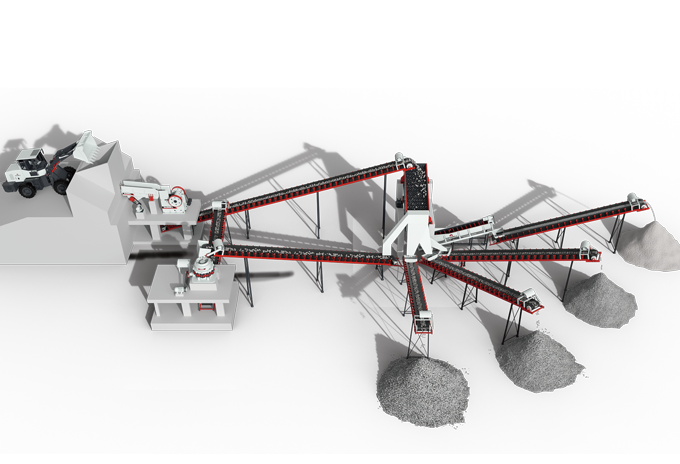
Steel slag crushing screening plant, also known as steel slag recycling plant, steel slag processing plant, steel slag recycling equipment, it is a complex plant that consists of crushing, grinding and separation.teel slag, a major solid waste from the steel industry with annual production exceeding 100 million tons in China alone2, poses significant environmental risks due to land occupation and potential pollution when stockpiled2. A steel slag recycling plant addresses this challenge through systematic processes and specialized equipment, transforming waste into valuable resources while promoting sustainability.
Usage of Waste Steel Slag
- Mixed with asphalt concrete for road construction. Steel slag is wear-resistant and corrosion-resistant and has a high hardness and rough surface. Therefore, after processing the raw material to about 15 to 25 millimeters, mix it into asphalt concrete for paving. This steel slag concrete material has high-temperature stability and low-temperature crack resistance, so its service life is much longer than ordinary asphalt concrete.
- Cement production for building materials. The formation temperature of steel slag is relatively high, generally above 1500 ℃, and it crystallizes tightly with a slower hydration rate. Therefore, steel slag cement will add an amount of gypsum and other admixtures to get a higher-strength product than ordinary cement. When used in construction materials, it can improve its crack resistance.
- Add blast furnace slag and other materials to make building bricks. Due to the higher hardness and better wear resistance of steel slag compared to other building aggregates, bricks made from steel slag also have the characteristics of good wear resistance and high strength.
- In addition, the processed steel slag can regulate soil PH and improve the environment. Make sintering solvents to increase sintering production capacity, etc.
Steel slag processing plant flow
After introducing the use of steel slag, here is the process of steel slag:
- Steel slag uniformly enters the jaw crusher through a vibrating feeder for coarse crushing treatment. After coarse crushing, the steel slag enters the vibrating screen for screening into materials of different particle sizes. If it does not meet the particle size requirements, the materials will return to the crusher machine for crushing.
- The material that meets the particle size requirements (about 10cm) enters a hydraulic cone crusher for intermediate and fine-crushing treatment. It also needs to go through vibrating screening equipment for screening. The material around 2cm directly enters the next stage, while those materials larger than 2cm return to the cone crusher for crushing. The next stage mainly depends on actual needs. If the required finished product is gravel, it will enter the magnetic separator for the iron removal process.
- If it requires fine powder, the material will enter the ball mill for grinding treatment. After the particle size meets the requirements, it will go through a magnetic separator for magnetic separation and get the final product.
- The price of processed steel slag powder is relatively higher, and it is the source of profit for the complete steel slag processing plant. The iron powder has a lower selling price with a larger quantity. Brick factories and cement plants will need the iron powder and purchase it. The crushing processing and reuse of steel slag are profitable and have a protective effect on the environment, so the recycling and utilization of steel slag are strongly supported and have a promising future.
Steel slag processing plant equipment
Jaw crusher
It is suitable for processing large steel slag materials (feed particle size ≤ 1200mm). It uses the principle of squeeze crushing, combined with a deep V-shaped and dead zone-free crushing chamber. There is no need to worry about material blockage. It uses wedge blocks to adjust the discharge port and reduce the labor intensity of workers and downtime. It is suitable for ores and rocks medium and fine crushing with compressive strength not exceeding 280MPa, especially for high-hardness and strongly corrosive materials. Its production range is 1-1000t/h.
Cone crusher
The cone crusher is widely used for the intermediate crushing processing of steel slag and adopts the laminated crushing method. The rolling mortar wall moves towards the crushing wall to squeeze materials.
Through hydraulic motor to adjust the discharge port, which is convenient and equipped with remote touchscreen operation to achieve safety operation.
A high-performance stone crusher is for the second and third-stage crushing processes of metal mines and construction sand and gravel processing. Due to its strong crushing capacity and large output, it is widely used for crushing medium-hard materials.
Impact crusher
The impact crusher is widely used in highway construction, water conservancy engineering, construction gravel, machine sand processing, and other fields for coarse crushing, medium crushing, and fine crushing operations of various soft and medium hard ores.
Ball mill
Steel slag belongs to a type of industrial waste. If not properly utilized, it will inevitably cause environmental pollution. The most suitable equipment for processing this mine is the ball mill. Steel slag through grinding can save energy and equipment costs, and the ball mill has good grinding ability and low overall energy consumption. Therefore, the common steel slag grinding equipment is steel slag ball mills.
Magnetic separator
The purpose of the steel slag process is to recover useful iron-containing components, including bulk iron, granular iron, and fine iron tetroxide. Due to the strong magnetism of the above components, the process of steel slag beneficiation is magnetic beneficiation, and the required equipment is a magnetic separator. The magnetic separation of steel slag includes dry-magnetic separation and wet-magnetic separation. Dry magnetic separation mainly recovers large blocks of iron, while wet magnetic separation recovers granular iron and iron tetroxide.
We usually choose suitable product models based on customer’s needs and specific requirements. Different product models have different prices. MINGYUAN is a professional mining equipment manufacturer with 38 years of rich experience in the mining construction industry. We can also provide lab equipment. Welcome to consult our professional team to get factory prices. According to your situation and product requirements, we will design a complete sand-crushing production line flow chart and provide an accurate quotation.
MINGYUAN Steel Slag Crushing Screening Plant: Integrated Recycling for Industrial Efficiency
A Steel Slag Crushing Screening Plant, also known as a steel slag recycling plant, steel slag processing plant, or steel slag recycling equipment, is a complete system designed to recover and repurpose the valuable components of steel slag. Steel slag, a byproduct of steelmaking, contains both metallic and non-metallic materials that can be transformed into valuable resources for construction and infrastructure projects.
MINGYUAN’s steel slag crushing screening plant integrates crushing, grinding, and magnetic separation in one comprehensive layout. The process starts with feeding and coarse crushing of the slag blocks, followed by screening to classify sizes, and magnetic separation to extract residual steel. Final products can include fine aggregate, road base material, and reusable steel particles.
🔧 Key Features of MINGYUAN Steel Slag Crushing Screening Plant
Fully integrated process: Combines crushing, screening, grinding, and separation in one system.
High efficiency: Optimized layout for continuous, automated production with minimal downtime.
Durable construction: Built to handle the abrasiveness and hardness of steel slag material.
Flexible capacity: Available in various configurations depending on the volume of slag and desired output.
Customizable layout: Mobile or stationary plant designs tailored to space and budget constraints.
✅ Advantages
Resource Recovery: Extracts valuable metallics and converts slag into usable materials.
Environmentally Friendly: Reduces the need for landfilling and promotes recycling.
Improved ROI: Converts waste into profit by producing construction-grade materials.
Low Maintenance: Heavy-duty components built for high reliability and reduced wear.
Adaptability: Compatible with blast furnace slag, electric arc furnace slag, and converter slag.
📐 Technical Parameters (Sample)
| Component | Capacity (t/h) | Input Size (mm) | Output Size (mm) | Power (kW) |
|---|---|---|---|---|
| Jaw Crusher | 80–300 | ≤1200 | 100–300 | 110–160 |
| Cone Crusher | 50–250 | ≤300 | 0–40 | 90–220 |
| Ball Mill | 5–15 | ≤65 | 0.074–0.4 | 130–210 |
| Magnetic Separator | 8–30 | ≤100 | Metal separation | 11–37 |
| Vibrating Screen | 50–300 | – | 0–5, 5–10, 10–20 | 15–45 per deck |
Note: Actual configurations can be tailored to project-specific requirements.
🧱 Applicable Materials
Basic oxygen furnace (BOF) slag
Electric arc furnace (EAF) slag
Ladle furnace slag
Blast furnace slag
Ferroalloy slag
🏗️ Applicable Fields
Metallurgical industry waste recycling
Cement and concrete production
Road and highway base layer construction
Aggregate manufacturing
Reuse in brick making and landfill cover
Core Processes in Steel Slag Recycling
The recycling process typically involves crushing, grinding, separation, and stabilization:
- Crushing and Grinding: Steel slag is first crushed and ground to break down bonding structures between slag, iron particles, and impurities. Advanced plants adopt multi-stage combined grinding processes, such as “roller press + ball mill,” “rod mill + vertical mill,” or “vertical mill + ball mill,” tailored to product requirements (e.g., uniform granularity or high reactivity via ultra-fine ball milling).
- Separation: After grinding, steel slag (containing 10%-30% metallic iron) undergoes magnetic separation to recover iron. Common equipment includes suspended permanent magnetic separators, flat magnetic separators, high-intensity magnetic separators, and drum-type magnetic separators, paired with screens (e.g., grid screens, single/double-layer vibrating screens) for size classification. A optimized magnetic separation process with secondary screening has achieved iron recovery rates of 93.20% for basic oxygen furnace slag and 85.82% for iron ladle slag.
- Stabilization: To remove free calcium oxide (f-CaO), slag undergoes aging (stockpiling), though this method is time-consuming and reduces reactivity.
Key Equipment Types
Specialized equipment ensures efficient processing:
- Grinding Mills: Roller presses, ball mills, rod mills, and vertical mills for particle size reduction.
- Magnetic Separators: Diverse types (permanent drum separators, tubular separators) for iron recovery.
- Screening Equipment: Vibrating screens for size grading.
- Auxiliary Devices: Tools facilitating slag removal in converters, such as those described in EU and Czech patents, which optimize slag utilization, reduce iron oxide content, and enhance metal yield.
Environmental and Resource Benefits
Recycling steel slag delivers substantial environmental and economic value:
- Resource Conservation: Recovering iron from slag reduces reliance on virgin ores, while recycled slag substitutes for raw materials in construction (e.g., road construction) and infrastructure.
- Pollution Reduction: Proper handling minimizes soil and water contamination from stockpiled slag, aligning with circular economy policies like China’s 14th Five-Year Plan for Circular Economy Development.
- Innovative Applications: China’s Yonggang Group exemplifies creative reuse, using recycled steel slag to 3D-print modular public toilets—constructed in ~15 days and designed for mobility and reusability.
International Practices
Global leaders in steel slag recycling demonstrate diverse strategies:
- Japan: Achieves nearly 100% slag reuse and explores novel applications, such as using steelmaking slag to create marine forests on offshore seabeds.
- China: Employs hot-stage processing and heat recovery technologies widely in steel plants, though提升转炉钢渣利用率 remains a key challenge.
Conclusion
Steel slag recycling plants, equipped with advanced crushing, grinding, and separation technologies, play a pivotal role in mitigating environmental risks and fostering resource efficiency. By integrating innovative processes and international best practices, the steel industry can transform slag from a liability into a sustainable resource, advancing global circular economy goals.